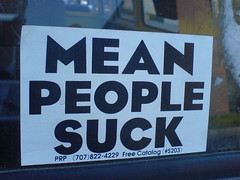
On LinkedIn Mean People Suck

162406031 e2dd36b3ac m On LinkedIn Mean People SuckWith that title I probably violated several things that I recommend doing (act professional, be careful of what you say and how you say it, etc.).  

I stumbled on a blog that was titled “The Stupid Things People Do on LinkedIn”.  The poster then proceeded to lash in to people that violated his perception of what LinkedIn should be and how people should behave on it.  My first thought was relax it’s not your site.  You’re just  another member.  The second was that did this person realize that their post was part of their online brand.

So there are two points to discuss.  The first is about your online brand.  The second is about unwritten protocols on LinkedIn that many people may not be aware of.

Your Online Brand
Remember this:  Everything you do on LinkedIn (and within the Social Web) either “adds to” or “subtracts from” your online brand.   This isn’t some college football board where you can denigrate and abuse fellow posters if you don’t like their view or comment.  There are no cute user names to hide behind.  On LinkedIn your comments are easily associated with the person behind them, YOU.

I don’t know the person behind the “stupid LinkedIn” post, but I already have an opinion of him.  Want to guess whether it’s positive or negative?  If this were a person that I was considering connecting to, partnering with, or engaging in their service, I would walk away.  There is enough negativity in the world without having to knowingly engage in it or with it.

This may not matter to him.  But it should to the average LI user.  When you ask or answer a question, post a discussion or news article in a group, add a blog to your profile, and how you respond to those who attempt to connect all contribute to your brand.  

Consider this.  You receive a connection invitation from John who works for an advertising agency.  You don’t know John so you mark the Invitation “I don’t know this user” (when you could have simply Archived It).  A couple of weeks later you connect to Bill who runs a graphics firm that you want to develop as a client.  You get an appointment and everything looks good.  Later John, who happens to engage Bill’s firm for his advertising agency notices that you are connected to Bill.  In their next conversation, John mentions that he saw that you and Bill were connected and mentions that you recently refused his connection invitation.  And rather than Archive it you marked it “I don’t know this user”.  Now his account has been restricted.  Bill thinks “that wasn’t a nice thing to do to John” and calls you to say they’ve decided to go in a different direction.

Is this an extreme story?  Yes.  Is it a possibility? Yes.  Your actions carry implications…some positive and some potentially negative.  Act in good faith and in a neighborly fashion and your brand will benefit.

The Unwritten Protocals
Over time acceptable practices evolve as do unacceptable ones.  As a member of LinkedIn you should adhere to the acceptable norms.  There aren’t to0 many and most are common sense, that often gets overlooked due to lack of time, imagination, or knowledge.  Here are some and I’m sure there are others that I have not thought of or encountered (violated) yet.

1.  Never send a canned invitation.  Always personalize the invitation.

2.  Don’t send out mass invitations.  It makes it difficult to personalize the email

3.  Don’t send out Mass Canned invitations…see #1 and #2

4.  When participating in answers or group discussions do not blatently sell.  How you phrase a sales pitch can be seen as spam or an interesting question or post.  Which of the two following statements is likely to be viewed as spam?

A.  Mortgage rates dropped to 4.5%, call me if you are looking to refinance; or
B.  With mortgage rates dropping to 4.5%, how do you determine if it’s a good idea to refinance your loan?

5.  Respond to all messages in your inbox.  If you don’t want to connect send a brief explanation as to why (see my post:  http://linkedintuition.com/blog/no-thanks-the-right-way ) .  Don’t feel comfortable providing a recommendation or passing on an introduction reply with why.

6.  Don’t ask for recommendations from people who don’t know you very well.  Recommendations should be appropriate and sincere.  It’s rude to ask when there’s no basis for one.

7.  Don’t expect everone to have the same approach that you do on LinkedIn.  Some are open networkers and some are closed networkers.  Each person decides what works best for them.  No one has a monopoly on the right way.

8.  If you do not want to connect, “Archive” the invitation.  Don’t select “I don’t know this user”.  Doing so gains you nothing and it can negatively impact another member.  Is it such an evil thing to want to connect to another that you do not know.  Isn’t that what networking is about.

Not everyone will agree with every point that I made.  Each person interacts with LinkedIn based on their expectations and beliefs and that’s a good thing.  What we should be able to agree on is that acting in a friendly and respectful manner will always do more good than harm.

What do you think?

share save 171 16 On LinkedIn Mean People Suck

Related posts:

  1. Why Do People Repeat Answers on LinkedIn?
  2. Why Do People Join LinkedIn Groups?
  3. LinkedIn Benefits Don’t Follow a Straight Line
  4. 13 LinkedIn Action Steps
  5. 5 Steps to Thrive on LinkedIn
About Sean Nelson

Sean has been a Keynote speaker at Norvax University, conducts social media workshops and webinars, and has released three books on LinkedIn and written several social media guides.

Sean currently runs Social Media Sonar, which in addition to providing free resources, manages social media strategies and tactics for companies. He is also a partner in Surge Labs, a conversion rate optimization company, helping companies improve conversions and profitability through scientific testing of Landing Pages, Websites, Email communications, and Shopping Carts.

Comments

  1. Karl Gibbons says:

    Outstanding – well done!
    Invaluable advice for everyone.

  2. J says:

    I think that is good advice

    I haven’t been personalizing my invites unless I’m really interested in something on their wall.
    I know better, my momma taught me better

  3. Brenda Webb says:

    I enjoyed your post very much. It makes good sense to me. I am relatively new myself and don’t know half as much as I need to know, but I am very sincere in being friendly on here. This is a good read to share with all newcomers. Thanks for the post!

  4. Rowena Cherry says:

    Thank you for this. You nail lots of great issues. It’s a pity some of the unwritten protocols aren’t written down, really!

    I disagree a little bit about your Point #4, though. If someone asks a question that interests me, and I click the link with the intention of trying to help, I feel that I’ve been tricked when a promising discussion turns out to be a sales pitch, and that opinions aren’t wanted at all…. unless there really is a discussion.

    Your tip on Archiving invitations is great, though. Mostly, I’ve just let the few I don’t want to accept sit. Now, I know how to safely clean up my inbox.

  5. Marie Pijanowski says:

    Good advice that is needed. Appreciate you taking the time. :)

  6. Daryl Mather says:

    It was my site and my post. I am sure I will survive without the incredible advantage of you linking to me, thanks.

    This year, since January, I have earned 7 figures from my networking activities on LinkedIn, so the post, and others like it, come from very deep and real experience. And a very strong benefits case. (And strangely without needing to attend any conferences or seminars on how to use LinkedIn, wow)

    I noticed that those who complained on the post did so because:

    a) They were doing it, or
    b) they sell stuff related to LinkedIn and therefore believe that they can paint themselves onto a higher ground through sycophancy and false sincerity. OR,
    c) They just didn’t get the message

    So here’s the message… If you want to leverage LinkedIn to make serious revenues in a short period of time then foolish practices like what I highlighted is not the way to do it.

    Also, although I notice you neglected to mention it, I praised one inmail I received, highlighting it as a very professional way to conect with other professionals on that platform.

    No comments on that??? Didn’t suit your purposes??

    In response to your post:

    1) What type of weak willed and easily offended people do you deal with? Really? (He sulked because you denied his connection? Really??? Are people really that concerned about what you think???)

    2) Point number 4 is all spam. One is overt and the other is sneaky and underhanded.

    3) Number 5 leads you to wasting time on LinkedIn spammers. Period, don’t waste your time.

    4) Number 6… wow. If you give a recommendation for someone falsely on LinkedIn then that is fraud. Real fraud, the sort that can mislead people into commercial decisions and can lead to very real litigation. Don’t do it, ever.

    And the rest doesn’t bear commenting on.

    I am surprised by this attack on me, and I am even more surprised that you were unable to really work out the meaning behind the post.

    mean people.. that is the best laugh I have had all day.

    If you want to really know how to make money on LinkedIn then start here.

    http://budurl.com/ljtg

    Toughen up…

  7. John McKay says:

    Great title for a book! Article had many good points; I’ve found LinkedIn helpful in both the job search process as well as a place more professional job placement people both look to for qualified candidates and use for references. I also find the groups a good exchange method for ideas, comment, and feedback. It’s kind of like shows, films etc that you don’t like – leave if it is not your thing – unless handcuffed to the chair :) .

  8. Sean says:

    Daryl,

    The reason the post does not link to you is because it wasn’t my intention to embarrass you or any such thing. Since you’ve identified yourself they can read your blog and make the determination for themselves.

    My next thought is that if you’ve made 7 Figures (1 million dollars) on LinkedIn since January what are you doing wasting your time here? You’re way to rich and successful to bother with us lower class folks.

    Most of the folks who disagreed with you on your site post did so based on the anger and rudeness in your posts. Some actually agreed with your comments but not the mean spiritedness behind them. I disagreed with both.

    You mention that you praised the use of Inmail for someone who did not know you to ask to connect. Good for you, it still doesn’t change the mean spiritedness that I wrote about.

    You also provide commentary on the following which I’ll try to adress one by one:
    You said: 1) What type of weak willed and easily offended people do you deal with? Really? (He sulked because you denied his connection? Really??? Are people really that concerned about what you think???)
    My Response: I have no clue what you are talking about. I’m not aware of anyone sulking because I would not connect to them. Likewise I don’t see me sulking if someone chooses to no connect.

    You said: 2) Point number 4 is all spam. One is overt and the other is sneaky and underhanded.
    My Response: To you it’s Spam, to others it’s not. I haven’t done it personally, but I’m OK with others doing it.

    You said: 3) Number 5 leads you to wasting time on LinkedIn spammers. Period, don’t waste your time.
    My Response: Maybe I’m not as popular as you, but I don’t find that I’m overwhelmed by spam. I choose to be courteous and reply and you don’t. That’s both of our rights to choose how we respond.

    You said: 4) Number 6… wow. If you give a recommendation for someone falsely on LinkedIn then that is fraud. Real fraud, the sort that can mislead people into commercial decisions and can lead to very real litigation. Don’t do it, ever.
    My Response: I think I said don’t ask for one from someone you don’t know. don’t give one unless it is sincere and appropriate. Not sure what you’re disagreement is here.

    If you read the post it’s not as much an attack on you as an attack on people who are rude to others who don’t conform to their visions of how to use LinkedIn. I would expect someone smart enough to make 7 figures using LI in 3 months to be able to get that. If you’re going to dish it out, the least you can do is not whine when it’s dished back.

    Good night Daryl. Tomorrow get out of the right side of the bed.

  9. David Breeze says:

    Superbly put, excellent post and great advice! But don’t mess with Daryl, he’s hard as nails!!

  10. Sameer Patil says:

    Linkedin has happened only because everyone needs to be networked. Today, I try to reach out to people with whom I have a business interest & at the same time there are a lot of people who want to reach out to me because of their business interest. It works out both ways. Also, never forget the fact that you never know whom you may need one day.

    Happy Linkingin to everyone. Cheerz…

  11. Anita Hampl says:

    First I ever realized that “I do not know this person” can lead to negative scoring (?) for them. Thanks for the tip to archive!

  12. Alison Findlay says:

    Sean-Very good and sound advice, nicely phrased. We all need to be a little more courteous and a little less proud.

  13. Kevin says:

    Though I agree with most of what you write, I continue to take exception to the use of “I don’t know this person.” I click that on 100% of the invites I get that contain the LI default one-liner invitation. (I respond differently to anyone that makes an effort)

    Seems to me that the responsibility here doesn’t belong to me — I responded honestly. The real accountability lies with the person who sent an unannounced, impersonal invitation to someone they never met. To do so and then “hope” that person doesn’t (truthfully) reply “I don’t know you” is a bit disingenuous. The “mean person” here is the person who thought it was ok to spam me with the invitation… you seem to make them the victim.

    Your one-in-a bazillion scenario you describe above is a chance I’m willing to take. And it wouldn’t be MY response that restricted the guy’s account — he obviously has made a habit of spam-inviting others who felt the same way.

    Knowing who you send invitations to is the sender’s responsibility. If you don’t like what Linkedin does when you do that, either stop it, or take it up with LinkedIn. I’m the only blameless one in the equation.

    And by the way, “connecting” on LinkedIn with someone you neither know, nor have tried to know, isn’t “networking.” It’s numbers/contacts building, and that’s not the same thing.

    Diatribe for the one comment with which i disagreed — sorry about that. I really did like the rest.

    But that’s just me…

    KB

  14. Sean says:

    Kevin,

    Thanks for the comments. Each person determines how they use LinkedIn and what works for them. All things being equal it’s as easy to hit the archive button as well as the “I don’t know” button. Within the invitations you receive will be some serial connectors and some who should know better but don’t (whether they are new to LinkedIn or just haven’t put much thought in to it). I don’t know which they are so I prefer to err on the side of giving them the benefit of the doubt.

    It is a one in a bazillian scenario and more likely to only occur within a specific area, say for instance Atlanta.

    You are correct that when you send out an unsolicited invitation you have taken the chance that the other person might not appreciate it. Failing to personalize the email just ups the anty and really doesn’t say much about you positively from a potential connection standpoint. In the end I agree that the fault lies with the sender and not the receiver. That being said, it’s just as easy to hit the Archive button.

    We’ll disagree on whether trying to connect with someone you don’t know is or isn’t networking. I would say networking is about building those relationships you do have and finding those that you do not currently have. Intent is what defines which it is. There are certainly people that are in it simply for the numbers, but there are others who realize that as the numbers increase so does opportunity (and I define that as opportunity to help yourself, help your network, and help others).

    Once again thanks for the comments. The perspectives I offer are simply mine and don’t represent the millions of other perspectives out there. They are a starting point for discussion that only truly becomes valuable when other add in their thoughts.

    **For the record I will usually accept invitations from others once I review their profile, but rarely do I send an invitation to someone I don’t know or don’t have something in common. Most of mine have been to other people who I have encountered that have a blog or write an article that I would like to know more about. The connection is the first step in starting a conversation that rarely is about dollars and cents.

    Warm Regards,

    Sean

  15. Melissa says:

    When LI used the Outlook invite that makes it more dificult to screen who you are inviting, even if it is a professional acquaintance and they say they don’t know you, it turns your request options off. Found this out the hard way, now I know better and will be far more selective in the future. I agree with “presentation is everything” and “first impressions count.” I just made a post, but I meant it and I’m hoping that my sincerity will wash all the taboos away in this climate of unemployment.

  16. Sean says:

    Melissa,

    I don’t know that posting here will cleanse all taboos, but it is appreciated. The Outlook invite tool makes it easy to send out a lot of invitations quickly but it can turn around and bite you. When I first started I sent out about 80 invitations that I loaded from Outlook. About 5 minuted later I read a article about having your account suspended if you received 5 “I don’t knows”. I sweated that one out but fortunately it worked out.

    Don’t be a stranger.

  17. E. Sheppard says:

    I haven’t read every comment here, but it seems that LinkedIn is finding its own code of conduct and the rules of politeness are being made by the users themselves right now. Its rules will be unique. Like any new mode of communication online, it has to be done on the fly – - and this is totally normal, but sometimes takes awhile. I think we will have differences of opinion on what is the totally correct and polite thing to do for awhile, and eventually everyone will come to a consensus.

    I think mainly it comes down to being as polite as possible to people online, and trying not to offend them.

    LinkedIn has been a boon to me personally. I like it! And I will be careful to archive any requests I either can’t complete right then, or need to think about first. I have learned a lot from this posting and from the comments, too. Thanks, everyone!

Trackbacks

  1. [...] This post was Twitted by StevieRogers – Real-url.org [...]

Speak Your Mind

*